


Resource curse: The Economic Warfare of Africa

The resource curse concept coined by Auty in 1993 describes when a country’s natural resources have adverse effects on its economic, social of political well-being. The core argument supported by robust evidence suggests a negative correlation between resource wealth and country’s governance. For instance, a study found that petroleum had three resource curse effects: countries with this resource were rigged with corruption, it caused office longevity of authoritarian regimes and triggered violent conflict in low-and middle income countries.
While there have been initiatives such as Kimberley Process Certification Scheme and the Extractive Industries Transparency Initiative launched by G20, Word Bank and the United Nations Development Program to stop the resource curse. This has not yielded to the desired results as many parts in the world and mostly in Africa are still entrapped to the resource curse, and at the epicentre is political instability compounded by poor governance. The African continent is endowed with rich natural resources, including minerals and fossil fuels. Production and exports in Africa's resource-rich economies are highly concentrated in natural resource-based products, but these economies have lower rates of economic growth.
Figure 1: Institutions and the resource curse
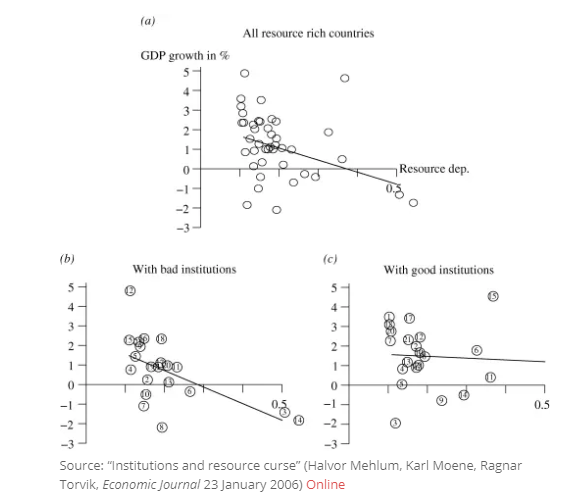
On the contrary, it’s also been argued that resources are not the curse rather institutional weakness are a major issue. A case in point is Norway and Botswana who have made effective use of their natural resources. Botswana is dependent on the diamond industry with 40% of GDP stemming from diamonds. But, between 1965 and 2002 had one of the world’s highest growth rates. Acemogluet al. (2002) attributed this performance to the good institutions of Botswana.
Economic warfare
Africa, a global mythical proportion and no doubt that its resources have led to geopolitical competition. The continent has become an economic warfare battlefield by global powers: China, U.S, Canada, India and E.U, all with different interests ranging from investment, infrastructure, foreign policy, military power, trade, soft power and geopolitics . To understand the source of this wave of interest on the continent let’s explore Africa’s resource audit and its share in resource world supply : Africa supplies 75 per cent of the world’s coltan, 9.6 per cent of the global oil output is produced in Africa, supplies 90 per cent of the world’s platinum and cobalt, ½ of the world’s gold supply, 2/3 of the world’s manganese is supplied by Africa, is the world supplier of 35 per cent of uranium and has 54 votes in the United Nations General Assembly.
How can the continent break the resource curse shackles and leverage on this wave of interest
African countries need to diversify their economic dependence away from single resource dependence. Further, a functioning democracy supported by good governance can lead to institutional confidence which is crucial to stop the resource curse phenomenon. By all accounts, African leaders need to understand the potential of the continent and the economic power they have to be able to negotiate deals that will economically emancipate the continent away from the usual rhetoric.

Comments